

News
eClinicalMedicine Publication
29th September 2025
Heparin Therapeutics is pleased to announce that two of its founders were lead and co-author on a recently published paper in a Lancet Group journal showing that inhaled, nebulised UFH is safe and significantly reduces intubation and mortality rates in ca. 500 hospitalised, non-intubated COVID-19 patients. These findings were also presented by our Prof. Frank van Haren at the European Respiratory Society Congress on September 28th 2025.
Please find a link to the article and also some press releases.
https://authors.elsevier.com/sd/article/S2589-5370(25)00271-8

Heparin Therapeutics Submits Response to FDA Drug Repurposing Initiative
15 June 2026
Heparin Therapeutics has submitted a response to the U.S. FDA’s initiative on drug repurposing for unmet medical needs, highlighting the potential of inhaled heparin as a promising therapeutic approach in respiratory disease.
Read our submission to the FDA:
FDA-2026-N-4492-0326 – Heparin Therapeutics Submission
Lung Publication
1st July 2026
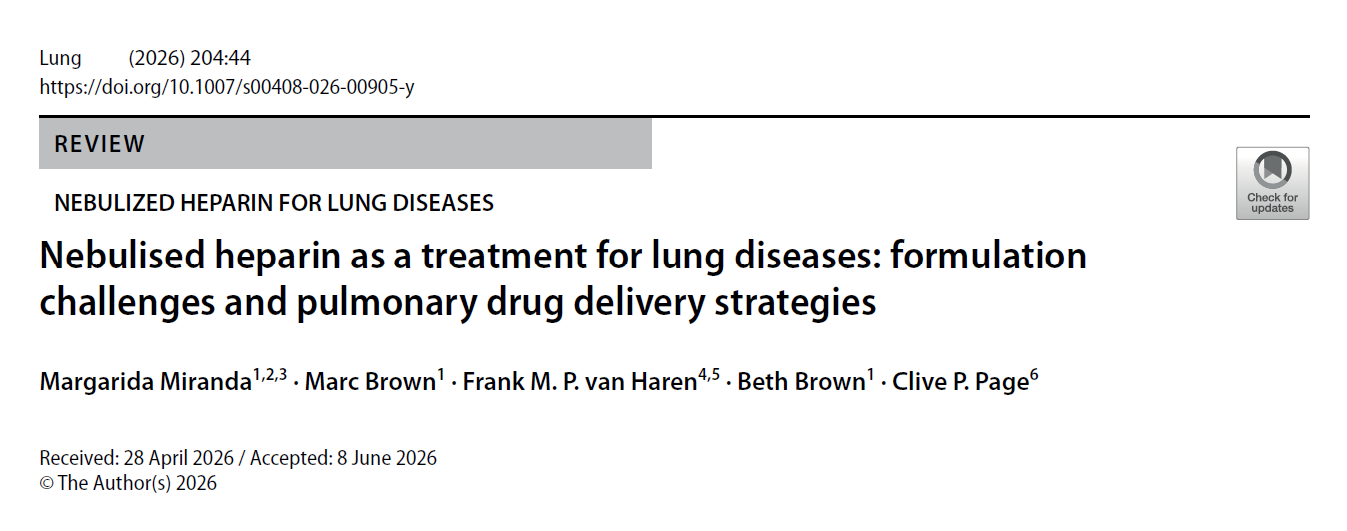
Heparin Therapeutics is pleased to announce the publication of a new review in Lung, highlighting the therapeutic potential of nebulised heparin across a range of respiratory diseases.
The review, co-authored by two of our founders, Prof. Marc Brown and Prof. Frank van Haren, together with colleagues, examines the growing clinical evidence for inhaled unfractionated heparin in conditions including COPD, asthma, ARDS and respiratory infections.
Importantly, the publication highlights both the promise of inhaled heparin and the technical challenges associated with existing off-label approaches, including formulation viscosity, nebuliser performance, dose delivery and lung deposition — reinforcing the need for a purpose-designed inhaled heparin product.
This provides further support for the scientific and development rationale behind HT-231, our next-generation inhaled heparin programme.
Read the publication: [PubMed – PMID 42384225]
DOI: 10.1007/s00408-026-00905-y
Partnerships


